The 2026 E-commerce Landscape: 5 Key Trends to Boost Your US Sales by 15%
The world of e-commerce is a relentless current, constantly shifting and evolving. To merely stay afloat is to risk being left behind; true success lies in anticipating the tides and riding the next wave. As we gaze into the not-so-distant future of 2026, the landscape of online retail promises to be more dynamic, personalized, and technologically advanced than ever before. For businesses aiming to not just survive but thrive, understanding and integrating the key 2026 E-commerce Trends is paramount. Our analysis suggests that embracing these transformative shifts can realistically boost your US sales by a significant 15% or more.
The United States, a colossal market for e-commerce, continues to set global benchmarks in consumer behavior and technological adoption. The pace of innovation in this sector is breathtaking, driven by ever-increasing customer expectations for convenience, speed, and hyper-personalization. Retailers who fail to adapt to these burgeoning demands will find themselves struggling against a tide of more agile and forward-thinking competitors. This comprehensive guide will dissect the five most impactful 2026 E-commerce Trends, offering actionable insights to help you strategically position your business for unparalleled growth.
Trend 1: Hyper-Personalization at Scale Driven by AI and Machine Learning
Gone are the days of generic marketing messages and one-size-fits-all product recommendations. The modern consumer, especially in the US market, expects a shopping experience tailored precisely to their individual preferences, past behaviors, and even real-time emotional states. This is where hyper-personalization, powered by advanced Artificial Intelligence (AI) and Machine Learning (ML), emerges as a dominant force among the 2026 E-commerce Trends.
AI and ML algorithms are becoming incredibly sophisticated at analyzing vast datasets of customer information – from browsing history and purchase patterns to demographic data and social media interactions. This allows e-commerce platforms to create highly accurate individual customer profiles, predicting not just what a customer might want, but when and how they want it. Imagine a customer browsing winter coats; an AI system could not only recommend coats in their preferred style and size but also suggest complementary accessories, offer a discount based on their loyalty status, and even remind them of a previous interaction with a similar product, all in real-time.
The Power of Predictive Analytics
Predictive analytics, a subset of AI, will revolutionize inventory management and demand forecasting. By accurately predicting future sales based on historical data, seasonal trends, and external factors (like weather or social media buzz), businesses can optimize their stock levels, reduce waste, and ensure products are always available when customers want them. This directly impacts customer satisfaction and reduces lost sales due to out-of-stock items, a crucial factor in boosting US sales.
Dynamic Content and Pricing
Hyper-personalization extends beyond product recommendations to dynamic content and pricing. Websites will adapt their layouts, imagery, and messaging based on individual visitor profiles. Pricing could also become more dynamic, offering personalized discounts or bundles to specific customer segments to encourage conversion, without devaluing the product for others. This level of granular control over the customer journey is a game-changer for the 2026 E-commerce Trends.
Actionable Steps for Hyper-Personalization:
- Invest in AI/ML Platforms: Explore solutions that offer robust data analysis, predictive modeling, and real-time personalization capabilities.
- Collect and Analyze Data Ethically: Ensure compliance with data privacy regulations (e.g., CCPA) while gathering comprehensive customer data.
- Segment Your Audience: Even before advanced AI, segmenting your audience based on basic criteria can kickstart personalization efforts.
- Personalize Email and SMS Campaigns: Tailor messages, product suggestions, and offers in your direct marketing channels.
- Implement Dynamic Website Experiences: Use tools that allow for A/B testing and dynamic content delivery based on user behavior.
By embracing hyper-personalization, businesses can foster deeper customer relationships, increase conversion rates, and significantly enhance customer lifetime value, making it a cornerstone of successful 2026 E-commerce Trends strategies.
Trend 2: The Rise of Immersive Shopping Experiences (AR, VR, and the Metaverse)
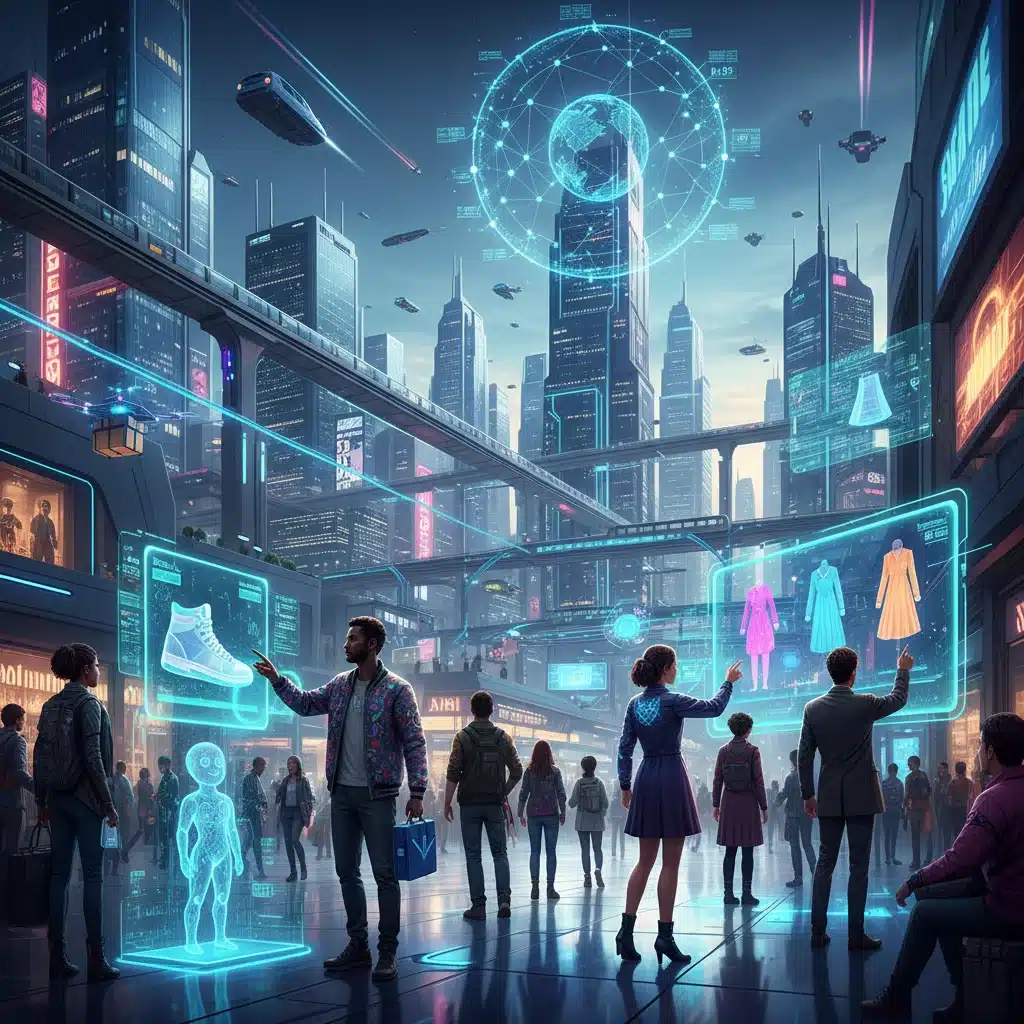
The boundaries between the physical and digital shopping worlds are blurring, giving rise to immersive experiences that promise to redefine how consumers interact with products online. Augmented Reality (AR), Virtual Reality (VR), and the nascent but rapidly evolving Metaverse are not just buzzwords; they are becoming integral components of the 2026 E-commerce Trends, particularly within the tech-savvy US market.
Augmented Reality (AR) for Product Visualization
AR technology allows customers to virtually try on clothes, place furniture in their homes, or test out makeup shades using their smartphone cameras. This removes much of the guesswork from online shopping, reducing return rates and increasing buyer confidence. Imagine trying on a new pair of sneakers from your couch, seeing exactly how they look on your feet, or arranging a new sofa in your living room before making a purchase. Retailers like IKEA and Sephora have already demonstrated the power of AR, and its widespread adoption will be a defining characteristic of 2026 E-commerce Trends.
Virtual Reality (VR) for Experiential Retail
While AR overlays digital content onto the real world, VR transports users into entirely digital environments. This opens up possibilities for virtual showrooms, interactive product demonstrations, and even virtual shopping malls where customers can browse and interact with products in a fully immersive 3D space. While still in its early stages for mainstream e-commerce, VR offers unparalleled opportunities for experiential retail, allowing brands to tell richer stories and create memorable shopping journeys.
The Metaverse: A New Frontier for E-commerce
The Metaverse, a persistent, interconnected virtual world, is perhaps the most ambitious of the immersive technologies. It envisions a future where users can work, play, socialize, and shop in a shared digital space. For e-commerce, this means new avenues for brand engagement, virtual product sales (e.g., NFTs, digital fashion), and entirely new business models. While the full realization of the Metaverse is still some years away, early adopters among the 2026 E-commerce Trends will be experimenting with virtual storefronts, digital collectibles, and immersive brand experiences within existing metaverse platforms.

Actionable Steps for Immersive Shopping Experiences:
- Explore AR Apps: Investigate existing AR platforms or develop custom AR experiences for your products (e.g., virtual try-on, product placement).
- Create 3D Product Models: Prepare your product catalog for immersive experiences by creating high-quality 3D models.
- Experiment with VR Showrooms: For high-value or complex products, consider creating virtual showrooms that offer a rich, interactive experience.
- Monitor Metaverse Developments: Stay informed about the leading metaverse platforms and consider pilot projects for brand presence or digital product sales.
- Partner with Tech Innovators: Collaborate with companies specializing in AR/VR development to leverage their expertise.
By embracing immersive technologies, businesses can differentiate themselves, enhance customer engagement, and provide a more compelling reason for consumers to shop online, thereby driving significant growth in US sales as part of the 2026 E-commerce Trends.
Trend 3: Sustainable and Ethical E-commerce Practices
Consumer consciousness regarding environmental and social impact is growing exponentially, and this trend will only intensify by 2026. Sustainable and ethical practices are no longer just a nice-to-have; they are becoming a fundamental expectation, especially among younger demographics in the US. Businesses that embed sustainability into their core operations and transparently communicate their efforts will gain a significant competitive advantage and build stronger brand loyalty, making this a critical aspect of 2026 E-commerce Trends.
Eco-Friendly Packaging and Shipping
The sheer volume of packaging waste generated by e-commerce is a major concern. By 2026, consumers will increasingly favor brands that use recyclable, biodegradable, or minimal packaging. Furthermore, optimizing shipping routes to reduce carbon emissions, offering carbon-neutral shipping options, and partnering with eco-conscious logistics providers will be key differentiators. Transparency about supply chain emissions will also be highly valued.
Ethical Sourcing and Production
Consumers want to know where their products come from and under what conditions they were made. Ethical sourcing of materials, fair labor practices throughout the supply chain, and transparent manufacturing processes will be crucial. Brands that can demonstrate a commitment to these values will resonate deeply with a growing segment of the market, impacting purchasing decisions and brand perception.
Circular Economy Models
The concept of a circular economy – where products are designed for durability, repair, reuse, and recycling – will gain significant traction. E-commerce businesses will explore models like product-as-a-service, repair programs, take-back schemes for old products, and marketplaces for refurbished or pre-owned items. This not only appeals to environmentally conscious consumers but also opens up new revenue streams and reduces resource dependency, aligning perfectly with progressive 2026 E-commerce Trends.
Actionable Steps for Sustainable E-commerce:
- Audit Your Supply Chain: Identify areas where you can improve environmental and social impact, from raw materials to final delivery.
- Adopt Sustainable Packaging: Switch to eco-friendly materials and minimize packaging size.
- Offer Carbon-Neutral Shipping: Partner with carriers offering green shipping options or invest in carbon offset programs.
- Promote Ethical Sourcing: Highlight your commitment to fair labor and sustainable material sourcing.
- Explore Circular Business Models: Consider offering repair services, trade-in programs, or selling refurbished products.
- Communicate Transparently: Clearly articulate your sustainability efforts on your website and marketing materials.
Integrating sustainable and ethical practices is not just good for the planet; it’s good for business. It builds trust, enhances brand reputation, and attracts a loyal customer base, contributing significantly to increased US sales in the context of the 2026 E-commerce Trends.
Trend 4: Conversational Commerce and Voice Search Optimization
The way consumers interact with brands is becoming increasingly conversational. The proliferation of voice assistants, chatbots, and messaging apps means that shopping journeys are no longer confined to website clicks. Conversational commerce, enabled by AI-powered tools, is set to become a major player in the 2026 E-commerce Trends, offering unparalleled convenience and a highly personalized interaction.
AI-Powered Chatbots and Virtual Assistants
Advanced chatbots will move beyond simple FAQs to become sophisticated sales assistants. They will be capable of understanding complex queries, offering personalized product recommendations based on past purchases and stated preferences, facilitating order placement, and even resolving customer service issues in real-time. This 24/7 availability and instant gratification will significantly improve the customer experience and drive conversions.
Voice Search Optimization
With the rise of smart speakers and voice-enabled devices, voice search is no longer a niche activity. Consumers are increasingly using voice commands to search for products, compare prices, and make purchases. E-commerce businesses must optimize their product listings and website content for natural language queries, focusing on long-tail keywords and conversational phrases. This means moving beyond traditional keyword stuffing to truly understand how people speak when they search, a critical adaptation for 2026 E-commerce Trends.
Shopping via Messaging Apps
Platforms like WhatsApp, Facebook Messenger, and Instagram DMs are evolving into powerful commerce channels. Brands will leverage these apps for direct customer communication, sending personalized offers, answering questions, and even completing transactions directly within the chat interface. This seamless integration of communication and commerce caters to the modern consumer’s preference for convenience and direct interaction.

Actionable Steps for Conversational Commerce and Voice Search:
- Implement Advanced Chatbots: Integrate AI-powered chatbots that can handle complex queries, offer product recommendations, and assist with purchases.
- Optimize for Voice Search: Conduct keyword research for conversational queries and adapt product descriptions and website content accordingly.
- Develop a Messaging App Strategy: Explore using platforms like WhatsApp Business or Messenger for direct sales, support, and personalized offers.
- Ensure Natural Language Processing (NLP) Capabilities: Invest in tools that can understand and respond to natural human language.
- Streamline Checkout Processes: Make it easy for customers to complete purchases once they’ve interacted via voice or chat.
By embracing conversational commerce and optimizing for voice search, businesses can meet customers where they are, provide instant assistance, and create a frictionless shopping experience that will be a hallmark of successful 2026 E-commerce Trends, leading to a substantial boost in US sales.
Trend 5: Seamless Cross-Channel and Headless Commerce
The modern customer journey is rarely linear. Consumers might discover a product on social media, research it on a brand’s website, compare prices on a marketplace, and then make a purchase via a mobile app. To cater to this fragmented journey, seamless cross-channel experiences and headless commerce architectures are becoming indispensable among the 2026 E-commerce Trends.
Unified Customer Experience Across All Touchpoints
Cross-channel commerce focuses on providing a consistent and unified experience regardless of where the customer interacts with your brand. This means product information, pricing, inventory availability, and customer service should be synchronized across your website, mobile app, social media channels, physical stores (if applicable), and third-party marketplaces. A customer should be able to start an order on their laptop and complete it on their phone without any hiccups.
Headless Commerce for Flexibility and Agility
Headless commerce refers to the decoupling of the front-end (what the customer sees) from the back-end (the commerce engine, inventory, payment processing, etc.). This architectural approach provides immense flexibility, allowing businesses to rapidly deploy new front-end experiences (e.g., a new AR app, a voice commerce interface, or a metaverse storefront) without having to re-engineer the entire e-commerce stack. This agility is crucial for keeping pace with the rapid evolution of 2026 E-commerce Trends.
The Importance of API-First Approach
An API-first approach is central to headless commerce. It means designing your e-commerce platform with robust Application Programming Interfaces (APIs) that allow different systems and applications to communicate seamlessly. This facilitates easier integration with new technologies, third-party services, and emerging channels, ensuring your e-commerce operation remains future-proof and adaptable.
Actionable Steps for Cross-Channel and Headless Commerce:
- Map Your Customer Journeys: Understand all potential touchpoints and identify areas for improvement in consistency and integration.
- Invest in a Unified Data Platform: Centralize customer data to ensure a single view of the customer across all channels.
- Evaluate Headless Commerce Solutions: Consider migrating to a headless architecture if your current platform limits your ability to innovate and expand to new channels.
- Prioritize API Integrations: Ensure your e-commerce platform can easily integrate with new technologies and third-party tools.
- Optimize for Mobile First: With the majority of online shopping occurring on mobile devices, a flawless mobile experience is non-negotiable.
By providing a seamless, consistent experience across all channels and adopting a flexible headless commerce architecture, businesses can reduce friction for customers, increase conversion rates, and ensure they are well-equipped to capitalize on every opportunity presented by the evolving 2026 E-commerce Trends, ultimately boosting US sales.
Conclusion: Navigating the Future of E-commerce for US Market Growth
The e-commerce landscape of 2026 will be characterized by a relentless pursuit of personalization, immersive experiences, ethical practices, conversational interactions, and seamless multi-channel engagement. For businesses operating in the highly competitive US market, merely acknowledging these shifts is not enough; proactive implementation is key to securing and expanding your market share.
The five 2026 E-commerce Trends – hyper-personalization via AI, immersive shopping with AR/VR/Metaverse, sustainable and ethical practices, conversational commerce and voice search, and seamless cross-channel/headless commerce – collectively paint a picture of an intelligent, customer-centric, and highly adaptable online retail environment. Each trend, when strategically adopted, offers distinct advantages that contribute to enhanced customer satisfaction, reduced operational costs, and ultimately, a significant uplift in sales.
Boosting your US sales by 15% is an ambitious yet entirely achievable goal for businesses willing to invest in these future-forward strategies. It requires a commitment to innovation, a deep understanding of evolving consumer behavior, and the courage to embrace new technologies. Start by evaluating your current e-commerce infrastructure, identifying gaps, and prioritizing the trends that align best with your business model and customer base.
The future of e-commerce is not just about selling products; it’s about creating unparalleled experiences, building trust, and fostering genuine connections with consumers. By diligently preparing for and adapting to these pivotal 2026 E-commerce Trends, your business can not only survive but truly thrive in the dynamic digital marketplace.