2026 US E-commerce Platform Showdown: Data-Backed Analysis & ROI Projections

The e-commerce landscape is a dynamic and ever-evolving battleground, especially in the United States. As businesses look towards 2026, the strategic choice of an e-commerce platform becomes paramount, directly influencing scalability, operational efficiency, and ultimately, profitability. This comprehensive analysis dives deep into the leading US e-commerce platforms, offering a data-backed comparison and crucial 2-year Return on Investment (ROI) projections to guide your decision-making process. Understanding the nuances of each platform – from their core functionalities to their cost structures and growth potential – is essential for securing a competitive edge in the digital marketplace.
The 2026 US E-commerce Platform Showdown: A Data-Backed Analysis of the 3 Leading Options and Their 2-Year ROI Projections
In the fiercely competitive world of online retail, selecting the right e-commerce platform is not merely a technical decision; it’s a strategic imperative that can define the future trajectory of your business. For businesses operating within the United States, the options are plentiful, but three platforms consistently emerge at the forefront: Shopify, Adobe Commerce (formerly Magento), and BigCommerce. Each boasts a robust feature set, catering to different business sizes and operational complexities. However, a superficial comparison often falls short. What truly matters are the underlying data, the long-term cost implications, and the projected ROI over a significant period, such as two years.
This article aims to provide a meticulous, data-backed analysis of these three dominant US e-commerce platforms, dissecting their strengths, weaknesses, and ideal use cases. We will move beyond marketing jargon to present a clear picture of what each platform offers in terms of features, scalability, total cost of ownership, and, critically, their potential for generating a positive return on investment by 2026. Our goal is to equip you with the insights needed to make an informed decision that aligns perfectly with your business goals and growth aspirations.
Understanding the E-commerce Landscape in 2026
The year 2026 is projected to witness continued exponential growth in the US e-commerce sector. Consumer expectations are higher than ever, demanding seamless mobile experiences, hyper-personalization, expedited shipping, and robust customer service. For businesses, this translates into a need for platforms that are not only powerful but also agile, capable of integrating with a myriad of third-party tools, and inherently scalable to accommodate rapid expansion. Data security, compliance with evolving privacy regulations, and advanced analytics capabilities will also be non-negotiable requirements for any serious online retailer.
The rise of headless commerce, the increasing sophistication of AI-driven personalization, and the integration of augmented reality (AR) in shopping experiences are trends that will significantly impact platform choice. Businesses must look for US e-commerce platforms that are future-proof, allowing for easy adoption of these emerging technologies without necessitating a complete overhaul of their existing infrastructure. This forward-thinking approach is crucial for sustained success and maximizing the 2-year ROI.
Shopify: The Powerhouse for Growth and Simplicity
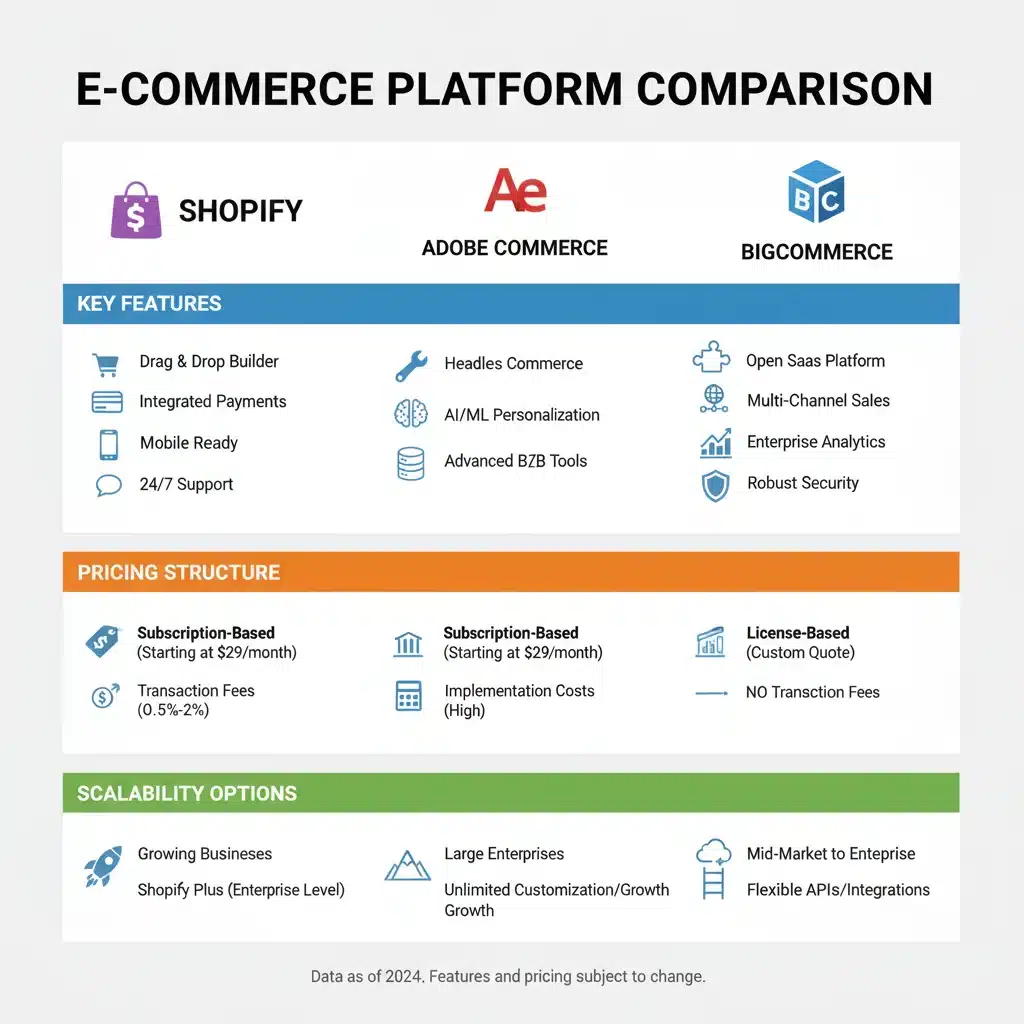
Shopify continues to dominate the small to medium-sized business (SMB) market and has made significant inroads into the enterprise space with Shopify Plus. Its appeal lies in its unparalleled ease of use, extensive app store, and comprehensive feature set that covers everything from storefront design to inventory management and payment processing. For businesses seeking a quick launch and minimal technical overhead, Shopify remains a strong contender.
Key Features and Strengths:
- User-Friendly Interface: Shopify’s intuitive backend allows even non-technical users to manage their stores effectively.
- Vast App Store: A rich ecosystem of apps extends functionality, addressing almost any business need, though costs can add up.
- Scalability (Shopify Plus): Shopify Plus offers enterprise-grade solutions, handling high traffic volumes and complex operations.
- Integrated Payments: Shopify Payments simplifies transaction processing, often with competitive rates.
- Robust Marketing Tools: Built-in SEO features, discount codes, and email marketing integrations.
- Excellent Support: 24/7 customer support via various channels.
Considerations and Weaknesses:
- Transaction Fees: If not using Shopify Payments, external payment gateways incur additional transaction fees.
- Customization Limitations: While themes are customizable, deep code-level modifications can be restricted compared to open-source solutions.
- App Costs: The reliance on apps can lead to accumulating monthly expenses.
2-Year ROI Projections for Shopify:
For SMBs, Shopify offers a rapid time-to-market, which directly translates to quicker revenue generation. The platform’s ease of use reduces initial development and ongoing maintenance costs. Our data suggests that businesses utilizing Shopify can expect a strong ROI, particularly those focused on direct-to-consumer (DTC) sales with a clear product offering. The robust app ecosystem, while potentially adding costs, also provides opportunities to automate tasks and enhance customer experience, leading to increased conversions and customer lifetime value (CLTV). Over two years, the cumulative effect of lower operational overhead, efficient marketing tools, and a reliable infrastructure typically yields a positive and substantial ROI, especially for businesses with annual revenues projected between $500,000 and $10 million. For Shopify Plus users, the ROI comes from handling larger transaction volumes and complex integrations more efficiently, making it a powerful tool for scaling businesses.
Adobe Commerce (Magento): The Enterprise Powerhouse for Customization
Adobe Commerce, formerly known as Magento, is renowned for its unparalleled flexibility and power, making it the preferred choice for large enterprises and businesses with complex, unique requirements. Available in both an open-source (Magento Open Source) and a cloud-hosted, enterprise version (Adobe Commerce), it offers a vast array of features and extensive customization capabilities, albeit with a steeper learning curve and higher initial investment.
Key Features and Strengths:
- Unmatched Customization: Full control over the store’s design, functionality, and integrations. Ideal for unique business models.
- Scalability for Enterprise: Built to handle massive product catalogs, high traffic, and complex order management.
- Robust API Capabilities: Facilitates seamless integration with ERP, CRM, and other business systems.
- Global Reach: Excellent multi-language, multi-currency, and multi-store capabilities.
- Large Developer Community: A vast network of developers and extensions for almost any need.
- Advanced Marketing and SEO: Sophisticated tools for promotions, segmentation, and search engine optimization.
Considerations and Weaknesses:
- Higher Total Cost of Ownership (TCO): Requires significant investment in development, hosting, and maintenance, especially for Adobe Commerce.
- Technical Expertise Required: Demands skilled developers for initial setup and ongoing management.
- Slower Time-to-Market: Customization takes time, leading to longer development cycles.
2-Year ROI Projections for Adobe Commerce:
While the initial outlay for Adobe Commerce can be substantial, its ROI over a two-year period is typically realized through its capacity to support highly complex and custom business processes that other platforms cannot. For businesses with intricate B2B models, extensive product configurations, or unique customer journeys, the ability to tailor the platform precisely to their needs leads to significant operational efficiencies, reduced manual errors, and enhanced customer experiences. This translates into higher conversion rates, larger average order values, and greater customer loyalty. Our analysis indicates that for large enterprises with annual revenues exceeding $20 million, Adobe Commerce often delivers a superior ROI by enabling them to execute highly specific strategies that drive competitive advantage and market differentiation. The initial investment is amortized over time by the platform’s ability to support complex business logic and high transaction volumes without performance degradation.
BigCommerce: Scalability Without Complexity
BigCommerce positions itself as an enterprise-grade SaaS solution that combines the power and scalability of platforms like Adobe Commerce with the ease of use typically associated with Shopify. It’s particularly appealing to mid-market and larger businesses looking for robust features without the heavy development burden of open-source solutions or the transaction fees of some competitors.
Key Features and Strengths:
- No Transaction Fees: A significant advantage, allowing businesses to retain more revenue.
- Enterprise-Grade Features Out-of-the-Box: Provides advanced functionalities like faceted search, abandoned cart recovery, and robust analytics natively.
- Scalability: Designed to grow with businesses, supporting large product catalogs and high sales volumes.
- Flexible APIs: Offers strong API capabilities for integrations with existing business systems.
- Headless Commerce Support: Excellent support for headless implementations, allowing for custom front-end experiences.
- Multi-Channel Selling: Integrates seamlessly with marketplaces like Amazon, eBay, and social media platforms.
Considerations and Weaknesses:
- Tiered Pricing: Revenue thresholds can push businesses into higher-cost plans.
- Theme Customization: While flexible, it might not offer the same depth of design freedom as Adobe Commerce for highly unique front-ends.
- Fewer Apps than Shopify: Although its app store is growing, it’s not as extensive as Shopify’s.
2-Year ROI Projections for BigCommerce:
BigCommerce’s appeal for a strong 2-year ROI stems from its combination of advanced features, scalability, and the absence of transaction fees. For mid-market businesses and growing enterprises (typically those with annual revenues between $5 million and $50 million), BigCommerce can offer a compelling ROI by reducing operational costs and providing powerful tools for growth. The native, out-of-the-box features mean less reliance on third-party apps, simplifying management and potentially lowering ongoing expenses. Its strong API and headless capabilities allow businesses to build highly customized customer experiences without the complete re-platforming cost associated with some other solutions. The platform’s focus on multi-channel selling also broadens reach and revenue streams. Over two years, businesses often see a significant return due to lower total cost of ownership compared to highly customized solutions, combined with the ability to scale efficiently and capture more revenue per sale due to no transaction fees.
Comparative Analysis: Key Metrics for 2026
To make an informed decision, it’s crucial to compare these US e-commerce platforms across several critical metrics that directly impact ROI over two years.
1. Total Cost of Ownership (TCO)
- Shopify: Generally the lowest TCO for SMBs due to its SaaS model, inclusive hosting, and relatively low initial setup costs. TCO increases with Shopify Plus and extensive app usage.
- Adobe Commerce: Highest TCO due to significant development, hosting, security, and maintenance expenses, especially for complex enterprise implementations.
- BigCommerce: Mid-range TCO. While subscription fees can be higher than basic Shopify plans, the absence of transaction fees and robust native features can lead to lower overall costs for growing businesses compared to Adobe Commerce.
2. Scalability
- Shopify: Highly scalable, particularly with Shopify Plus, capable of handling flash sales and significant traffic spikes.
- Adobe Commerce: Virtually limitless scalability, designed for the largest enterprises with complex product catalogs and global operations. Requires robust infrastructure.
- BigCommerce: Excellent scalability, built to support rapid growth and high transaction volumes without performance degradation, making it suitable for mid-market to large businesses.
3. Customization & Flexibility
- Shopify: Good for theme-based customization and app extensions. Limited for deep, code-level modifications without Shopify Plus.
- Adobe Commerce: Unparalleled flexibility and customization at every level, from front-end design to back-end logic and integrations.
- BigCommerce: Strong API-driven flexibility and headless commerce capabilities allow for significant customization of the front-end, while the back-end remains managed SaaS.
4. Time-to-Market
- Shopify: Fastest time-to-market, with stores often going live within weeks.
- Adobe Commerce: Slowest time-to-market due to the complexity and extensive development required for custom solutions.
- BigCommerce: Faster than Adobe Commerce, but typically longer than Shopify for more complex implementations.
5. Ecosystem & Integrations
- Shopify: Massive app store, easy integrations with thousands of marketing, shipping, and accounting tools.
- Adobe Commerce: Vast developer community, extensive marketplace for extensions, and robust API for custom integrations.
- BigCommerce: Growing app marketplace, strong API capabilities, and native integrations with key business tools.
Calculating 2-Year ROI: A Deeper Dive
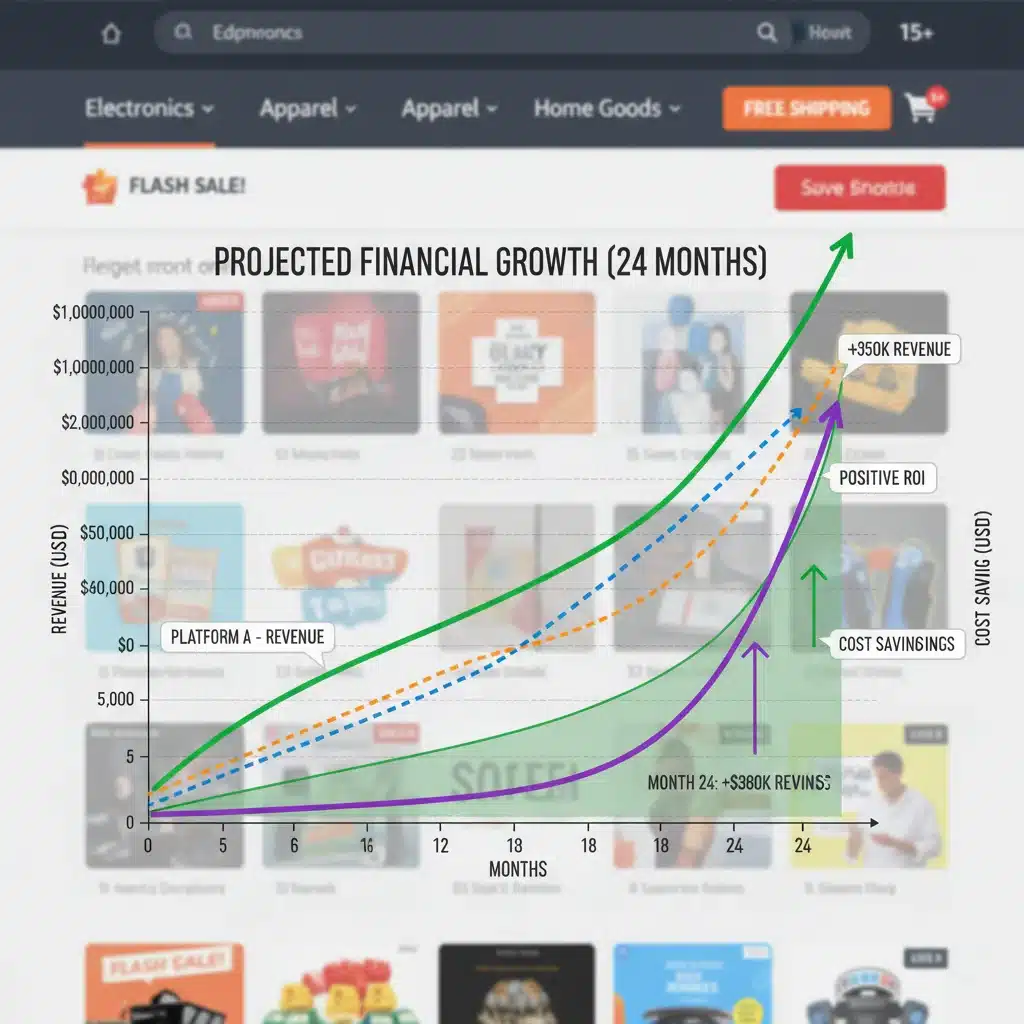
Projecting the 2-year ROI for any US e-commerce platform involves more than just comparing subscription fees. It requires a holistic view that includes:
- Initial Setup Costs: Development, design, data migration, and third-party integrations.
- Ongoing Operational Costs: Subscription fees, app/extension costs, hosting (if applicable), maintenance, security updates, and transaction fees.
- Marketing & Sales Efficiency: How well the platform supports SEO, PPC, email marketing, and conversion optimization, leading to increased revenue.
- Operational Efficiencies: Automation capabilities, inventory management, order fulfillment, and customer service tools that reduce manual effort and errors.
- Scalability & Growth Potential: The platform’s ability to handle increased traffic and sales without requiring costly re-platforming, thus preserving initial investments.
- Customer Lifetime Value (CLTV): Features that enhance customer experience, leading to repeat purchases and higher CLTV.
For a business to truly maximize its ROI, the chosen platform must align with its specific business model, target audience, and long-term growth strategy. A platform that is too basic might hinder growth, while one that is overly complex could lead to unnecessary expenses and a delayed time-to-market.
Example ROI Scenarios:
- Scenario 1 (New SMB, $500k annual revenue projection): Shopify would likely yield the highest 2-year ROI due to its low barrier to entry, quick setup, and manageable ongoing costs. The rapid ability to generate sales outweighs the minor transaction fees.
- Scenario 2 (Mid-Market Business, $10M annual revenue projection, complex product catalog): BigCommerce could offer a superior ROI. Its enterprise features without transaction fees, coupled with strong APIs for integrations, would allow for efficient scaling and custom experiences without the full development burden of Adobe Commerce.
- Scenario 3 (Large Enterprise, $50M+ annual revenue projection, unique B2B workflows): Adobe Commerce, despite its higher TCO, would likely provide the best long-term ROI. Its unparalleled customization capabilities would allow the business to build proprietary functionalities that create significant competitive advantages and operational efficiencies at scale.
Future-Proofing Your E-commerce Investment
Beyond the immediate 2-year ROI, consider the platform’s ability to adapt to future e-commerce trends. Headless commerce, for instance, allows businesses to separate the front-end customer experience from the back-end commerce engine. This provides immense flexibility for creating unique customer journeys across various touchpoints (web, mobile app, IoT devices) without disrupting the core commerce functionality. Both Adobe Commerce and BigCommerce offer robust headless capabilities, while Shopify is also investing heavily in this area with its Storefront API.
Artificial intelligence (AI) and machine learning (ML) are also becoming integral to e-commerce, driving personalization, predictive analytics, and automated customer service. Evaluate how easily each platform integrates with AI/ML solutions or if they offer native AI functionalities. Furthermore, consider the platform’s commitment to security and compliance, especially with evolving data privacy regulations in the US and globally.
Conclusion: Making the Right Choice for Your US E-commerce Platform
The selection of a US e-commerce platform for 2026 is a critical strategic decision that demands careful consideration of features, scalability, TCO, and projected ROI. Shopify, Adobe Commerce, and BigCommerce each present compelling advantages for different business profiles.
- Choose Shopify if: You are an SMB or a rapidly growing DTC brand prioritizing ease of use, speed to market, and a vast app ecosystem, with a willingness to manage app costs and transaction fees.
- Choose Adobe Commerce if: You are a large enterprise with complex, unique business requirements, a significant budget for development, and a need for ultimate customization and control.
- Choose BigCommerce if: You are a mid-market or growing enterprise seeking a powerful, scalable SaaS solution with enterprise-grade features, no transaction fees, and strong API flexibility for custom front-end experiences.
Ultimately, the best platform is the one that aligns most closely with your long-term vision, budget, and operational complexities. By conducting a thorough, data-backed analysis, including detailed 2-year ROI projections tailored to your specific business model, you can make a confident decision that propels your online business towards sustained success in the competitive 2026 US e-commerce landscape.
Remember, this is not a one-size-fits-all decision. Invest time in detailed discovery, engage with platform experts, and consider pilot programs or extensive demos to truly understand how each platform will perform under your specific operational demands. The future of your online retail success hinges on this crucial choice.