Mobile-First E-commerce US: Optimising for 70% Online Transactions by 2026

Mobile-First E-commerce in the US: Optimising for a 70% Share of Online Transactions by Mid-2026
The digital storefront of tomorrow is already here, and it fits right in the palm of your hand. In the United States, the seismic shift towards mobile-first e-commerce is not just a trend; it’s a foundational reshaping of how consumers interact with brands and make purchases. Projections indicate that by mid-2026, an astounding 70% of all online transactions in the US will originate from mobile devices. This isn’t merely a statistic; it’s a clarion call for businesses to fundamentally rethink their digital strategies. Those who embrace this mobile-first imperative will thrive; those who don’t risk being left behind in an increasingly competitive landscape. Understanding and optimising for this monumental shift is no longer optional—it’s critical for survival and growth.
The implications of this forecast are profound. It means that for every ten online sales, seven will be completed on a smartphone or tablet. This dominance necessitates a paradigm shift in how businesses design, develop, and market their online presence. It moves beyond simply having a responsive website; it demands a holistic mobile-first approach where the mobile experience is the primary consideration, not an afterthought. This comprehensive guide will delve into the critical aspects of optimising for this future, exploring everything from user experience and technical performance to marketing strategies and payment solutions, all geared towards capturing that lucrative 70% share of mobile e-commerce US transactions.
The Unstoppable Rise of Mobile E-commerce in the US
To truly grasp the magnitude of the 70% projection, it’s essential to understand the underlying forces driving the growth of mobile e-commerce US. Several factors contribute to this relentless ascent, painting a clear picture of why a mobile-first strategy is paramount:
- Ubiquity of Smartphones: Nearly every American adult owns a smartphone. These devices are no longer just for communication; they are powerful mini-computers, entertainment hubs, and, crucially, shopping portals. The constant accessibility of a smartphone means consumers can shop anytime, anywhere, transforming idle moments into purchasing opportunities.
- Improved Mobile Networks and Technology: Advances in 5G technology and increasingly sophisticated mobile processors have made mobile browsing faster, smoother, and more reliable than ever before. This eliminates many of the frustrations that once plagued mobile shopping experiences, such as slow loading times and dropped connections.
- Enhanced Mobile UX Design: As businesses recognise the importance of mobile, there’s been a concerted effort to improve mobile user experience (UX). Intuitive interfaces, larger buttons, simplified navigation, and touch-friendly designs make shopping on a small screen a pleasure, not a chore.
- Social Commerce Integration: Social media platforms, primarily accessed via mobile, have become powerful e-commerce channels. Features like in-app shopping, shoppable posts, and direct messaging with businesses seamlessly blend social interaction with purchasing intent, further blurring the lines between browsing and buying.
- Digital Wallet Adoption: Mobile payment solutions like Apple Pay, Google Pay, and various proprietary apps have streamlined the checkout process, making it incredibly fast and secure. The removal of friction at the payment stage is a significant driver of increased mobile conversions.
- Personalisation and AI: Mobile devices are treasure troves of data, enabling highly personalised shopping experiences. AI-powered recommendations, push notifications tailored to individual preferences, and location-based offers all contribute to a more engaging and effective mobile shopping journey.
These factors collectively create an environment where mobile is not just an option for shopping but often the preferred, most convenient, and most engaging method. For businesses, ignoring these dynamics is akin to ignoring the very customers they aim to serve. The future of mobile e-commerce US is not coming; it’s already here, and it’s demanding attention.
Pillars of a Successful Mobile-First E-commerce Strategy
Achieving that 70% mobile transaction share requires a deliberate and comprehensive strategy built on several key pillars. It’s about more than just a responsive website; it’s about an entire ecosystem designed for the mobile user.
1. Uncompromising Mobile User Experience (UX) and User Interface (UI)
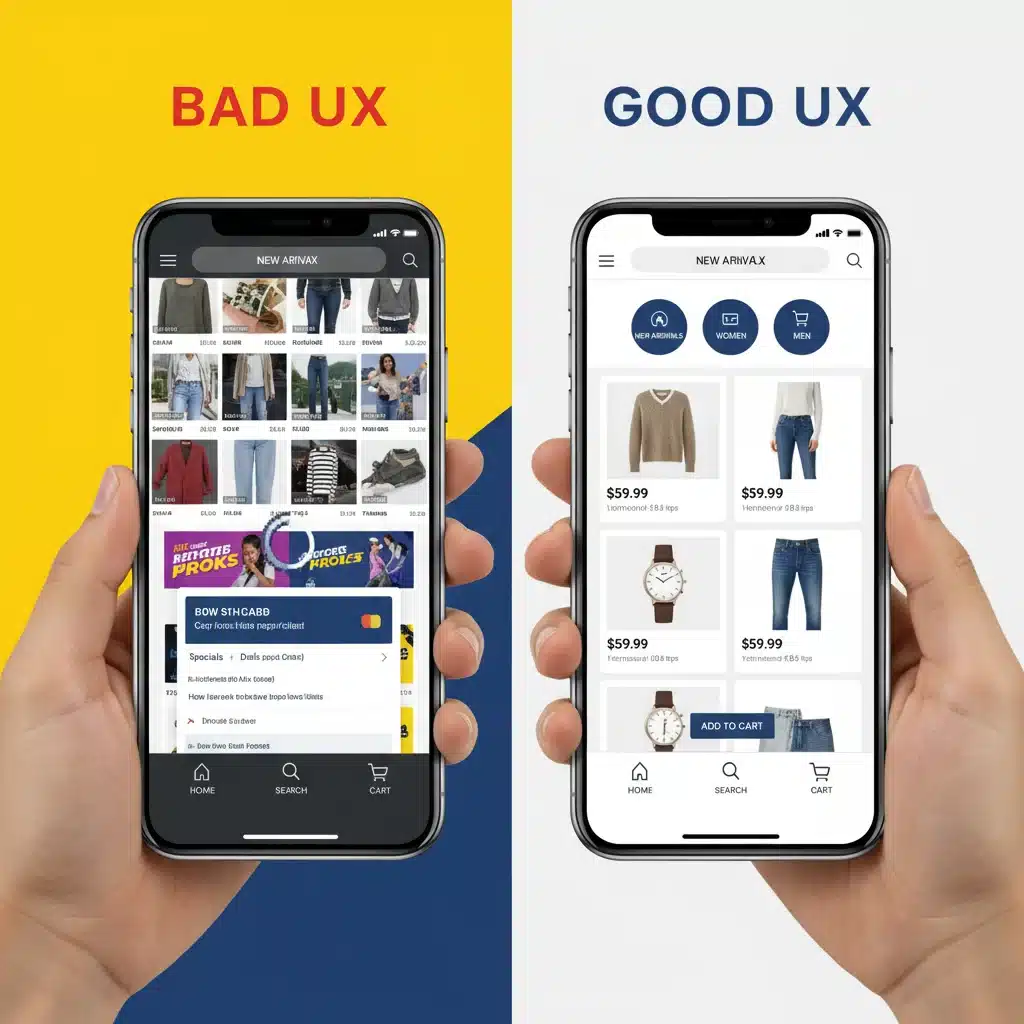
The cornerstone of any successful mobile e-commerce US strategy is an exceptional mobile UX/UI. This goes far beyond simply fitting your desktop site onto a smaller screen. It requires a fundamental shift in design thinking:
- Responsive Design vs. Mobile-First Design: While responsive design adapts content to screen size, mobile-first design starts with the smallest screen and progressively enhances for larger ones. This ensures that the core functionalities and content are prioritised for mobile users, avoiding unnecessary clutter.
- Speed and Performance: Mobile users are notoriously impatient. Pages must load instantly. Optimise images, leverage caching, minimise code, and use Content Delivery Networks (CDNs) to ensure lightning-fast loading times. Google’s Core Web Vitals are crucial metrics here.
- Intuitive Navigation: Simplify menus, use clear calls to action (CTAs), and ensure that navigation is thumb-friendly. Hamburger menus are common, but consider alternative navigation patterns that keep key actions visible.
- Touch-Friendly Elements: Buttons, links, and form fields must be large enough and spaced appropriately for easy tapping with a thumb or finger. Avoid tiny text and cramped layouts.
- Optimised Product Pages: Product images should be high-quality and zoomable, but also optimised for quick loading. Product descriptions should be concise and scannable, with key information presented upfront. Customer reviews should be easily accessible.
- Streamlined Checkout Process: This is where many mobile sales are lost. Minimise the number of steps, offer guest checkout options, integrate popular digital wallets (Apple Pay, Google Pay, PayPal), and auto-fill forms where possible. Progress indicators can also reduce abandonment.
- Accessibility: Ensure your mobile site is accessible to users with disabilities. This includes proper colour contrast, readable font sizes, and screen reader compatibility.
Every element, from the initial landing page to the final purchase confirmation, must be meticulously crafted to provide a seamless, enjoyable, and efficient experience on a mobile device. A clunky, slow, or difficult-to-navigate mobile site will quickly drive customers to competitors.
2. Technical Optimisation for Mobile Search and Performance
Beyond the visual and interactive elements, the underlying technical architecture must be robustly optimised for mobile. This directly impacts SEO and overall user satisfaction in the realm of mobile e-commerce US.
- Mobile SEO: Google’s mobile-first indexing means your mobile site is the primary version used for ranking. Ensure your mobile content is complete, crawlable, and indexable. Optimise for local search, as many mobile users are looking for nearby businesses.
- Accelerated Mobile Pages (AMP) / Progressive Web Apps (PWAs): Consider implementing AMP for critical landing pages or PWAs for an app-like experience without the need for an app store download. PWAs offer offline capabilities, push notifications, and fast loading, bridging the gap between web and native apps.
- Image and Video Optimisation: Compress images without sacrificing quality. Use modern formats like WebP. For videos, ensure they are hosted efficiently and load quickly, or provide options for users to play them.
- Server Response Time: A fast server response time is crucial. Invest in reliable hosting and consider using a CDN to deliver content quickly to users regardless of their geographical location.
- Error Handling: Implement clear and helpful error messages for forms, payments, and other interactions. Prevent users from getting stuck in a frustrating loop.
3. Personalisation and Engagement Strategies
Mobile devices offer unparalleled opportunities for personalisation, which can significantly boost engagement and conversion rates in mobile e-commerce US.
- AI-Powered Recommendations: Leverage AI to provide personalised product recommendations based on browsing history, purchase behaviour, and even real-time interactions.
- Push Notifications: Use push notifications strategically to alert users about sales, abandoned cart reminders, new arrivals, or back-in-stock items. Ensure they are timely, relevant, and not overly intrusive.
- Location-Based Marketing: For brick-and-mortar businesses, use geo-fencing to send relevant offers to customers when they are near your store.
- In-App Messaging/Chatbots: Provide instant customer support and guidance through chatbots or in-app messaging, addressing queries quickly and efficiently.
- Loyalty Programs: Integrate loyalty programs directly into the mobile experience, allowing customers to easily track points, redeem rewards, and receive exclusive mobile-only offers.
4. Secure and Seamless Mobile Payment Solutions
The checkout process is a critical juncture. Any friction here can lead to abandonment. For mobile e-commerce US, secure and varied payment options are non-negotiable.
- Digital Wallets: Integration with Apple Pay, Google Pay, Samsung Pay, and PayPal is essential. These offer one-tap payments, significantly reducing checkout time and increasing convenience.
- Saved Payment Information: Allow returning customers to securely save their payment details for even faster checkout.
- Multiple Payment Options: Beyond digital wallets, offer traditional credit/debit card options and potentially alternative payment methods popular in your niche.
- Robust Security: Reassure customers about the security of their transactions. Display trust badges and ensure PCI DSS compliance.
- Clear Pricing and Shipping: Display all costs upfront, including shipping and taxes, to avoid surprises at checkout. Transparency builds trust.
Marketing and Acquisition in the Mobile-First Era
Optimising your mobile site is only half the battle; you also need to attract customers to it. Marketing strategies must also evolve to be mobile-centric for mobile e-commerce US dominance.
1. Mobile-Optimised Advertising
- Social Media Ads: Design ads specifically for mobile platforms like Instagram, TikTok, Facebook, and Pinterest. Use short, engaging videos and high-quality images.
- Search Engine Marketing (SEM): Ensure your Google Ads and other PPC campaigns are targeted and optimised for mobile users, including mobile-specific ad copy and landing pages.
- In-App Advertising: Explore advertising within other popular mobile applications relevant to your target audience.
2. Content Strategy for Mobile
- Short-Form Video: The rise of TikTok and Instagram Reels demonstrates the power of short, engaging video content. Use this format for product showcases, tutorials, and brand storytelling.
- Interactive Content: Quizzes, polls, and interactive product configurators can significantly boost engagement on mobile.
- Blog Content: Ensure your blog articles are easily readable on mobile, with short paragraphs, clear headings, and optimised images.
3. Leveraging Mobile Apps (Where Appropriate)
While a PWA can often suffice, a native mobile app might be beneficial for businesses with high customer loyalty, frequent purchases, or complex functionalities. Apps offer deeper personalisation, push notification capabilities, and often a more seamless user experience. However, consider the development and maintenance costs. For many, a highly optimised PWA is a more cost-effective and equally effective solution for mobile e-commerce US.
Measuring Success and Continuous Optimisation
To ensure you’re on track to capture that 70% share of mobile e-commerce US transactions, continuous monitoring and optimisation are crucial. Rely on data, not assumptions.
- Analytics Tools: Utilise tools like Google Analytics (with a focus on mobile segments), Firebase, and other mobile-specific analytics platforms to track key metrics.
- Key Performance Indicators (KPIs): Monitor mobile conversion rates, bounce rates, average session duration, page load times, abandoned cart rates, and mobile revenue.
- A/B Testing: Continuously test different elements of your mobile experience—CTA button colours, checkout flow variations, image placements, and more—to identify what resonates best with your audience.
- User Feedback: Solicit feedback directly from mobile users through surveys, in-app prompts, and usability testing. Their insights are invaluable.
- Competitor Analysis: Keep an eye on what your competitors are doing well (and not so well) in the mobile space. Learn from their successes and failures.
The mobile landscape is dynamic. What works today might not work tomorrow. A mindset of continuous improvement and adaptation is essential to stay ahead in the fast-paced world of mobile e-commerce US.

The Future is Mobile: Preparing for 2026 and Beyond
The projection of 70% of online transactions in the US being mobile-originated by mid-2026 is not a distant future; it’s just around the corner. Businesses that are not actively investing in and prioritising their mobile strategy now will find themselves at a significant disadvantage. This isn’t about simply keeping up; it’s about leading the charge.
Consider the broader implications: mobile devices are not just shopping tools; they are integral to every aspect of modern life. They are used for communication, entertainment, information gathering, and increasingly, for commerce. This deep integration means that a seamless mobile shopping experience feels natural and expected. Any friction or difficulty stands out starkly against the backdrop of an otherwise fluid digital existence.
The businesses that will truly dominate the mobile e-commerce US market are those that:
- Embrace Innovation: Continuously explore new mobile technologies, from augmented reality (AR) for product visualisation to voice commerce integrations.
- Prioritise Security and Trust: As mobile transactions become more prevalent, the emphasis on data security and privacy will only grow.
- Personalise at Scale: Leverage data to create hyper-personalised experiences that make each customer feel uniquely understood and valued.
- Integrate Seamlessly: Break down silos between online and offline experiences, using mobile as the bridge.
- Focus on Speed and Efficiency: Time is a precious commodity; mobile experiences must respect that.
The shift to mobile-first is an opportunity, not a threat. It’s an opportunity to connect with customers where they are, in the way they prefer to interact. By committing to a robust mobile-first strategy today, businesses can not only meet the 2026 projection but exceed it, solidifying their position as leaders in the evolving landscape of mobile e-commerce US.
Conclusion
The rapid acceleration of mobile e-commerce US is undeniable. With 70% of online transactions expected to occur via mobile devices by mid-2026, the imperative for businesses to adopt a comprehensive mobile-first strategy has never been stronger. This involves much more than just a responsive website; it demands an unwavering focus on mobile user experience, technical performance, personalised engagement, and secure payment solutions. By meticulously optimising every touchpoint for the mobile user, from lightning-fast load times and intuitive navigation to streamlined checkouts and targeted marketing, businesses can not only meet but exceed customer expectations. The future of retail is undeniably mobile, and those who proactively embrace this transformation will be well-positioned to capture a significant share of the burgeoning online market, fostering loyalty and driving sustainable growth in the years to come.